MCR
What it is
Origin
MCR stands for Mahjong Competition Rules. China published these rules in 1998, designed for competition. In 2006 the World Mahjong Organization (WMO) published the rulebook in English, known as the Green Book.
Today it is the basis of the tournaments of the Spanish Federation and of the EMA (European Mahjong Association).
Tiles
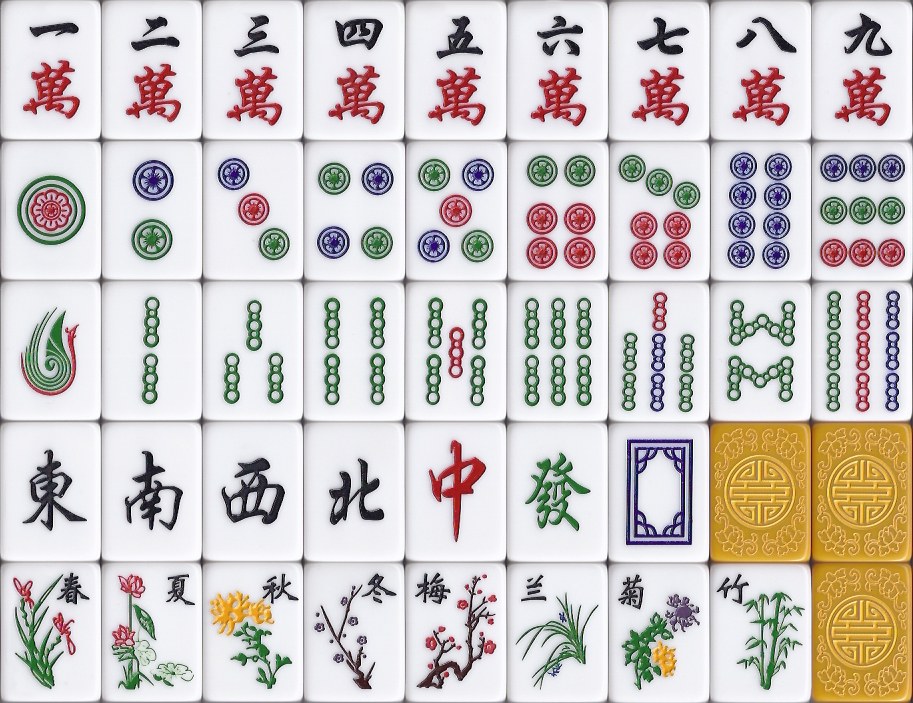
The game uses 144 tiles:
- Three numbered suits from 1 to 9 (circles, bamboos and characters), with four copies of each tile.
- Four winds and three dragons, also with four copies.
- Eight flowers, all different.
Flowers are not part of the sets in your hand. Each one adds 1 point, but that point does not count towards the 8-point minimum you need to win.
The hand
A winning hand has 14 tiles, normally arranged in four sets and a pair. A set can be:
- a chow: three consecutive numbers of the same suit;
- a pong: three identical tiles;
- a kong: four identical tiles.
There are also special hands that do not follow this structure, such as seven pairs or thirteen orphans.

Scoring
To win, your hand must be worth at least 8 points. Each pattern has a fixed value between 1 and 88 points, and there are 81 different patterns. The values of all the patterns your hand meets are added up, although there are rules that stop the same pattern from being counted twice.
When you win, each opponent pays you 8 points. On top of that you collect the value of the hand: only the player who gave you the discard pays it, or all three opponents if you win by self-draw.
How the game works
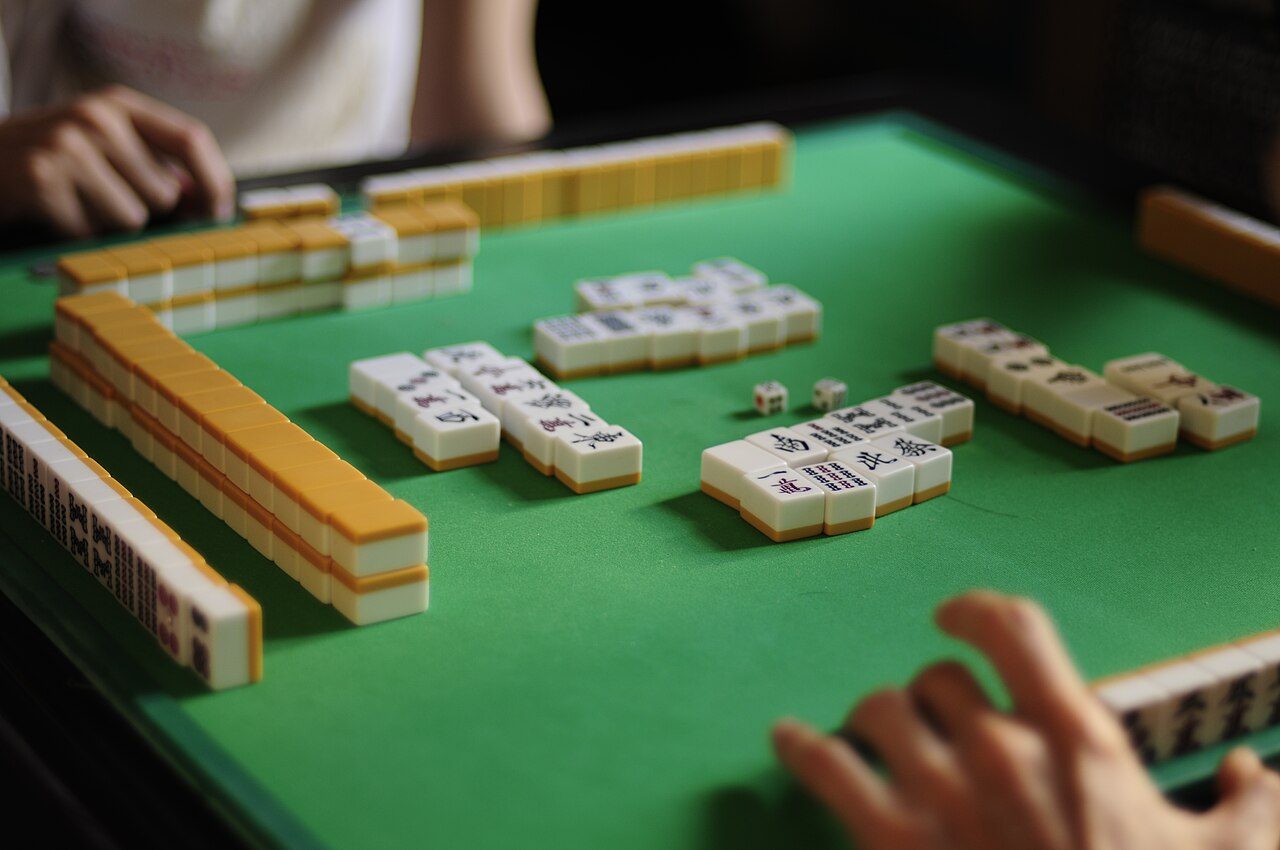
A full game has four rounds of four hands, so 16 hands in total. In every hand the players rotate seats, whoever wins.
On your turn you draw a tile and discard another one. You can win on the discard of any player. You can also take a discard to make a pong or a kong. To make a chow, the discard must come from the player on your left.
Strategy
In MCR there is no fixed hand to aim for. You decide which patterns to look for according to the tiles you receive, and you change your plan when needed.
Since the hand needs 8 points, many hands are built by adding up several small patterns. Calculating quickly how much each option is worth is one of the most important skills.
Also, nobody announces that they are waiting to win. That is why it pays to watch the discards and the exposed tiles of your opponents to guess what they are looking for.
Spread
MCR was born in China and it is played in tournaments in Europe and Asia. The EMA keeps a European MCR ranking (opens in a new tab) and organises European championships.
Official rules
This is the official rulebook that the EMA uses for MCR.
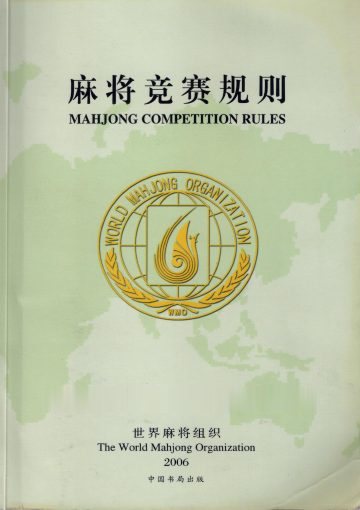
Green Book
Official MCR rulebook. The World Mahjong Organization published it in 2006. The EMA uses it in its tournaments.
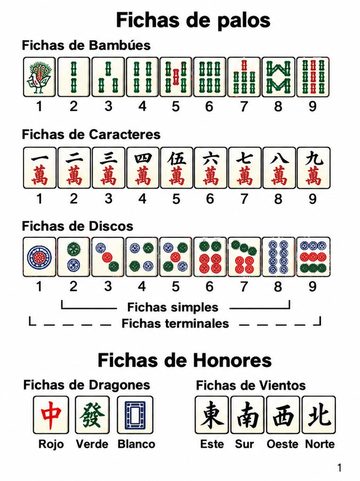
Basic Mahjong guide
A three-page summary to get started: tiles, melds, basic rules, and example hands for MCR and Riichi. It is only in Spanish.
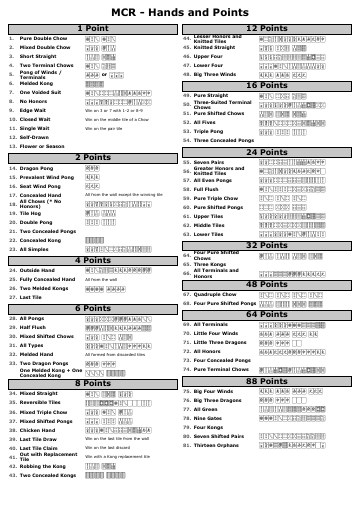
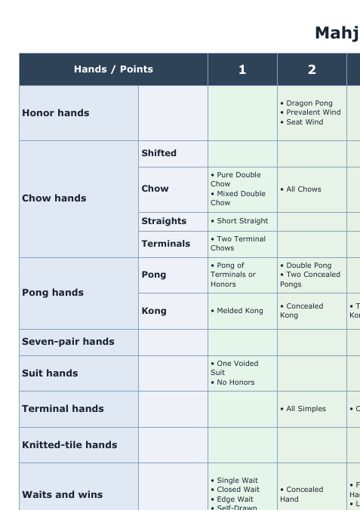
Patterns summary
The MCR patterns with their value, in two formats. Use the list to see an example with tiles. Use the table to review the values.
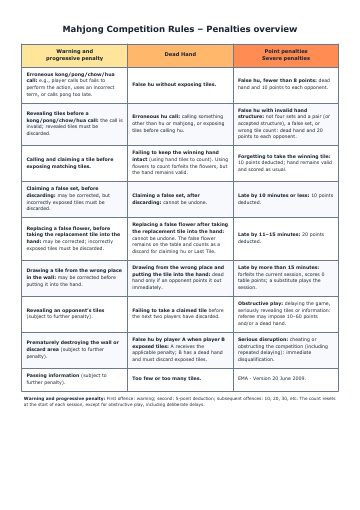
Penalties summary
The penalties of the EMA competition rules on one sheet. They range from a warning to disqualification.
More documents and rules on the EMA (opens in a new tab) website.
Guides and books
- MCR Handbook on MahjongSoft (opens in a new tab). Books and manuals about MCR in the Books section.
- World-Class Mahjong with World Champion Mai Hatsune (opens in a new tab). Strategy book for MCR by Mai Hatsune, the first world champion, and Takunori Kajimoto. Free English translation in the Mahjong Museum of Takeshobo. PDF version (opens in a new tab).
- Beyond the Green Book (opens in a new tab). Comments about the 2006 MCR rules, to understand better the Green Book. In English.
Videos
We have not added MCR videos yet. More are coming soon.
Exercises and practice
- Practice table. A virtual table to practise and teach. Drag the tiles and let them snap together.
- MahjongSoft (opens in a new tab) has an MCR trainer, a hand calculator and games against bots.
- Mahjong Time (opens in a new tab) lets you practise against bots, in both MCR and Riichi.
Where to play
To play MCR online, see Play online. MahjongSoft (opens in a new tab) and Mahjong Time let you play MCR.
For games in person, see Play in Asturias. If you want to learn with other people, join the WhatsApp group (opens in a new tab) and ask for a class.