
Riichi
Riichi is Japanese Mahjong. You may know it from anime such as Akagi (opens in a new tab), Saki (opens in a new tab) or Mudazumo Naki Kaikaku (opens in a new tab). It is a fast game with a lot of defense, which reduces the luck factor compared with the MCR rules. It is the most widespread mode in the world, and Japan even has professional leagues.
What it is
Origin
Riichi is Japanese Mahjong. It came to Japan from China in the early 20th century and developed its own rules there, such as the riichi declaration that gives it its name.
In European tournaments it is played with the EMA RCR rules (Riichi Competition Rules). The current edition is the 2025 one.
Tiles
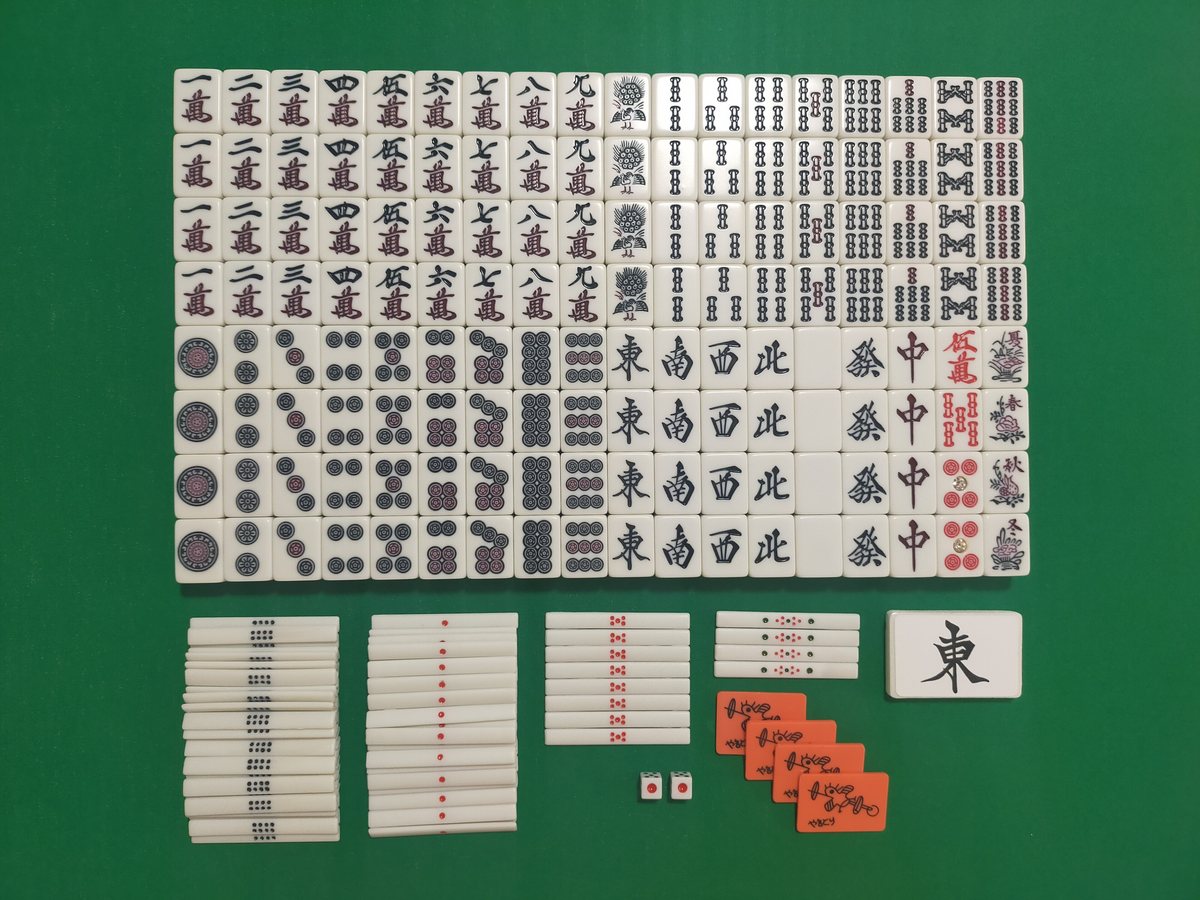
The game uses 136 tiles:
- three numbered suits from 1 to 9;
- four winds and three dragons.
Each tile has four copies and there are no flowers.
Riichi sets usually include four extra red fives. Some variants use them and they work as dora, but the EMA does not allow them.
Points are counted with tenbō, which are point sticks. Each player starts with a fixed amount and they pass the sticks when they pay. In MCR, in contrast, points are written on paper.
The hand
A winning hand has 14 tiles. Usually it has four sets and a pair, although seven pairs and thirteen orphans also win.
To be able to win, the hand needs at least one yaku, which is a valid pattern from the rulebook. Valuable tiles are not enough: dora, which are bonus tiles, add han, but they do not count as a yaku.

Scoring
The score comes from two numbers:
- Han measure the value of the patterns and of the dora. Each extra han doubles the base value of the hand.
- Fu are base points that depend on the sets, the pair and the way you win.
With han and fu you look up a table to find out how many points are paid. From 5 han the hand is a limit hand with a fixed value: mangan, haneman, baiman or sanbaiman. Yakuman is the top hand.
You can find the tables and an explanation of how to count fu in the Riichi sheet (opens in a new tab).
Riichi
When your hand is concealed and one tile away from winning (this is called tenpai), you can declare riichi. You put down a bet of 1,000 points and from then on you can no longer change your hand.
In return, riichi is a yaku by itself and it can give you ura dora, which are hidden dora revealed when you win.
How the game works
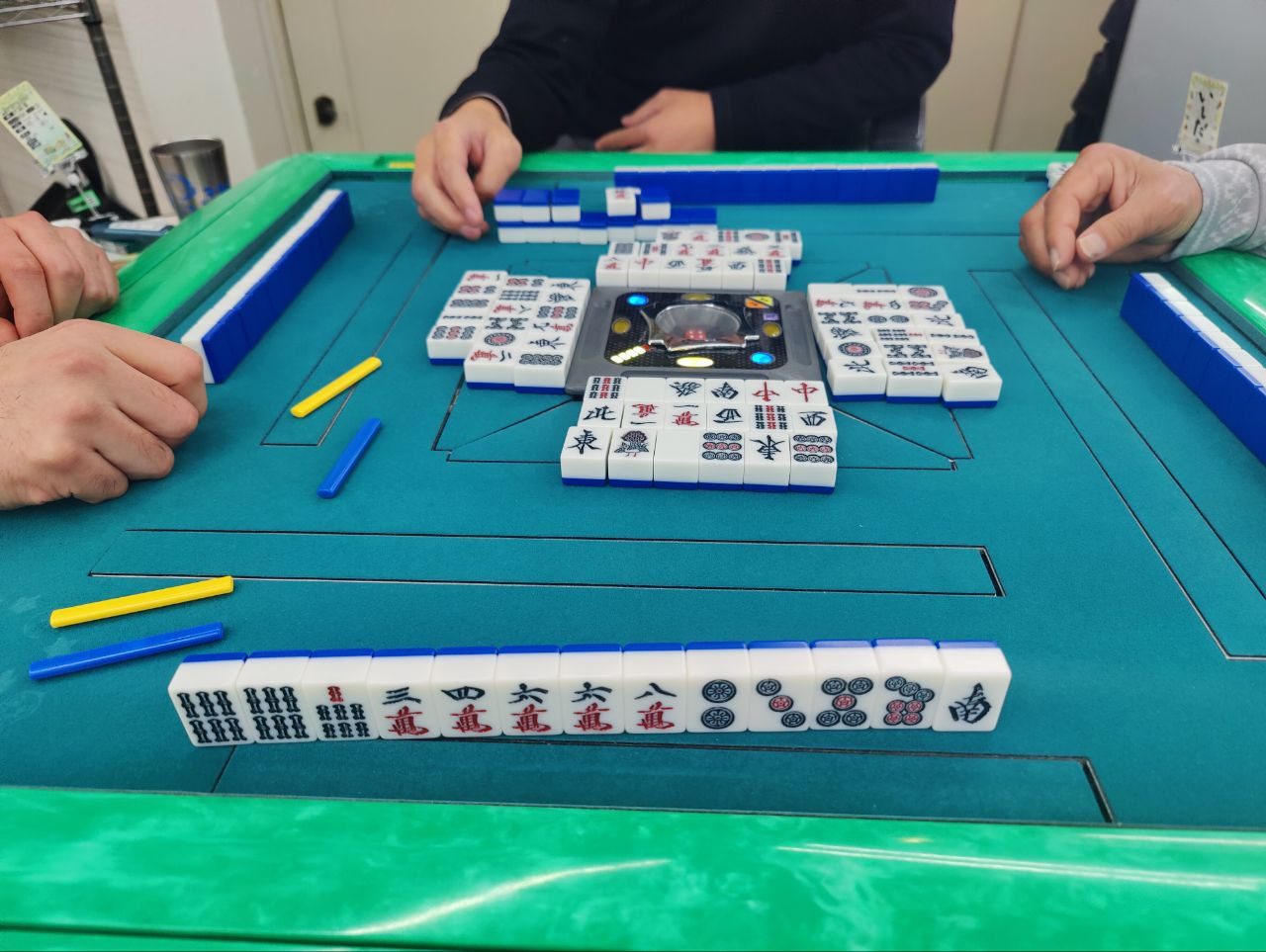
A full game has two rounds, the East round and the South round, and each round has at least four hands. East stays East if East wins, or if East is in tenpai when the hand ends with no winner. East also stays after a chombo, which is a serious offence.
Counters add points for the winner: 300 if they win on a discard, or 100 from each opponent if they win by self-draw.
Strategy
With every discard you have to choose between attack and defence. If an opponent declares riichi, it is often worth giving up your hand so you do not have to pay.
You also have to watch out for furiten: if you have discarded any of the tiles that would complete your hand, you cannot win on another player’s discard, even if it suits you now.
Spread
It is the most played mode in the world. In Japan it has professional leagues and a strong presence in anime and video games, and you can play it online on platforms such as Mahjong Soul or Tenhou.
Official rules
This is the official rulebook that the EMA uses for Riichi.
Riichi Competition Rules (RCR)
Official EMA Riichi rulebook. 2025 edition.
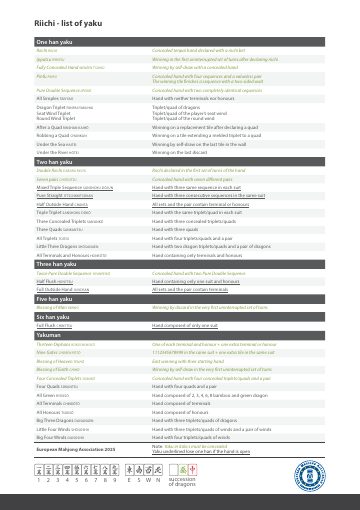
Riichi sheet: yaku, rules and scoring
Four A4 pages to print. Yaku list, summary of the main rules, scoring tables and how to count fu. EMA 2025 edition.
More documents and rules on the EMA (opens in a new tab) website.
Guides and books
- Riichi Beginners Guide (PDF, English) (opens in a new tab). A short guide to start with Riichi.
- Riichi Mahjong (opens in a new tab). Book by Edgar Rubio Rodilla, president of the Spanish Mahjong Federation. On sale at Amazon.
Videos
A Riichi course in four parts. A Japanese player explains the game. It has Spanish subtitles. Mahjong Madrid links to the same course.
- How to play Japanese Mahjong, part 1 of 4 (opens in a new tab). Kintarros. Spanish subtitles.
- How to play Japanese Mahjong, part 2 of 4 (opens in a new tab). Kintarros. Spanish subtitles.
- How to play Japanese Mahjong, part 3 of 4 (opens in a new tab). Kintarros. Spanish subtitles.
- How to play Japanese Mahjong, part 4 of 4 (opens in a new tab). Kintarros. Spanish subtitles.
Exercises and practice
- Practice table. A virtual table to practise and teach. Drag the tiles and let them snap together.
- Mahjong Soul (opens in a new tab) has a Riichi tutorial inside the game.
- Mahjong Time (opens in a new tab) lets you practise against bots, in both MCR and Riichi.
- Mahjong Efficiency Trainer (opens in a new tab). It teaches you to choose the best discard in Riichi.
Where to play
To play Riichi online, see Play online. Mahjong Soul (opens in a new tab) is the best platform to start. You can also use MahjongSoft (opens in a new tab), Mahjong Time (opens in a new tab), Riichi City (opens in a new tab) or Tenhou (opens in a new tab).
For games in person, see Play in Asturias. If you want to learn with other people, join the WhatsApp group (opens in a new tab) and ask for a class.